Monday, May 13, 2013

GOVERNANCE & CONFLICT (Nigeria)

"The hospital morgue in Maiduguri, Nigeria, where large numbers of bodies have been brought." (Adam Nossiter/The New York Times)
Bodies Pour In as Nigeria Hunts for Islamists
By Adam Nossiter
The New York Times, May 7, 2013
"A fresh load of battered corpses arrived, 29 of them in a routine delivery by the Nigerian military to the hospital morgue here. Unexpectedly, three bodies started moving. 'They were not properly shot,' recalled a security official here. 'I had to call the JTF' -- the military's joint task force -- 'and they gunned them down.' It was a rare oversight. Large numbers of bodies, sometimes more than 60 in a day, are being brought by the Nigerian military to the state hospital, according to government, health and security officials, hospital workers and human rights groups -- the product of the military’s brutal war against radical Islamists rooted in this northern city. The corpses were those of young men arrested in neighborhood sweeps by the military and taken to a barracks nearby. Accused, often on flimsy or no evidence, of being members or supporters of Boko Haram -- the Islamist militant group waging a bloody insurgency against the Nigerian state -- the detainees are beaten, starved, shot and even suffocated to death, say the officials, employees and witnesses. Then, soldiers bring the bodies to the hospital and dump them at the morgue, officials and workers say. The flood is so consistent that the small morgue at the edge of the hospital grounds often has no room, with corpses flung by the military in the sand around it. Residents say they sometimes have to flee the neighborhood because of the fierce smell of rotting flesh. From the outset of the battle between Boko Haram and the military, a dirty war on both sides that has cost nearly 4,000 lives since erupting in this city in 2009, security forces have been accused of extrajudicial killings and broad, often indiscriminate roundups of suspects and sympathizers in residential areas. The military's harsh tactics, which it flatly denies, have reduced militant attacks in this insurgent stronghold, but at huge cost and with likely repercussions, officials and rights advocates contend.

Friday, March 22, 2013

GOVERNANCE & CONFLICT / FAMILY & SEXUALITY (India)

"Indian women hold a protest in New Delhi after the fatal gang rape of a student there in December." (Prakash Singh/AFP/Getty Images, January 2, 2013)
Critics Say India Rape Law Opens Way to More Abuse
By Mark Magnier
The Los Angeles Times, March 21, 2013
"Vijendera Kumar has been sentenced to work and live in a cow shed for six months, feeding and bathing the animals and shoveling their dung 10 hours a day, seven days a week, after eloping at 17 with his girlfriend. That is in addition to a year the laborer spent in jail. 'They didn't even investigate my case,' Kumar said, surrounded by 300 lumbering beasts. 'Punishing young people for having consensual sex is unfair and backwards.' Among the most controversial provisions of anti-rape legislation passed Thursday in India's Parliament -- in hurried response to public anger over the fatal mid-December gang rape of a 23-year old physiotherapy student -- was a provision setting the age of sexual consent at 18. But even before the law passed, Indian law was flexible enough, as Kumar learned, to make consensual sex among teenagers risky, a paradox in a society where rape has often gone unpunished and marriages are still arranged among the young. Reformist lawmakers argued in recent days that the age of consent should be 16 to prevent wrongful arrests in a changing society, but conservatives prevailed, fearful that a lower age would encourage premarital sex and undermine Indian morality. It was fixed at 16 from 1983 until February, when an ordinance moved it higher. Critics say the higher age opens the way for further abuses because parents frequently file rape and kidnapping charges against boys who have consensual sex with their daughters, consigning the boys to jail and the girls into quickly arranged marriages to 'protect their honor.'

Monday, March 11, 2013

GOVERNANCE & CONFLICT (Syria)

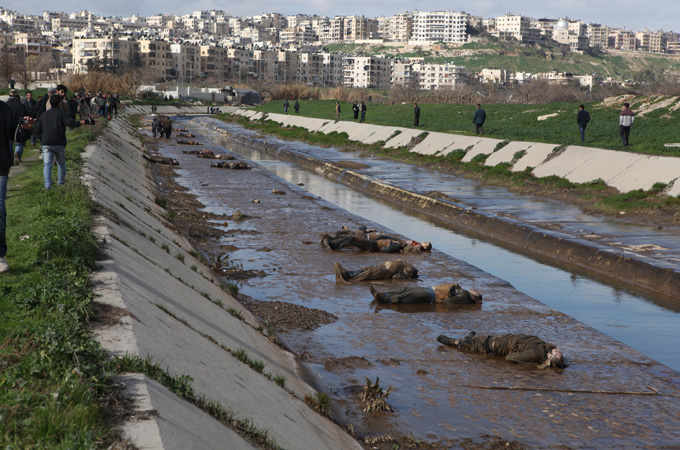
"Bodies revealed by the Queiq river's receding waters." (Thomas Rassloff/EPA)
Syria: The Story behind One of the Most Shocking Images of the War
By Martin Chulov
The Guardian, March 11, 2013
"It is already one of the defining images of the Syrian civil war: a line of bodies at neatly spaced intervals lying on a river bed in the heart of Syria’s second city Aleppo. All 110 victims have been shot in the head, their hands bound with plastic ties behind their back. Their brutal execution only became apparent when the winter high waters of the Queiq river, which courses through the no man’s land between the opposition-held east of the city and the regime-held west, subsided in January. It's a picture that raises so many questions: who were these men? How did they die? Why? What does their story tell us about the wretched disintegration of Syria? A Guardian investigation has established a grisly narrative behind the worst -- and most visible -- massacre to have taken place here. All the men were from neighbourhoods in the eastern rebel-held part of Aleppo. Most were men of working age. Many disappeared at regime checkpoints. They may not be the last to be found. Locals have since dropped a grate from a bridge, directly over an eddy in the river. Corpses were still arriving 10 days after the original discovery on January 29, washed downstream by currents flushed by winter rains. Just after dawn on 29 January, a car pulled up outside a school being used as a rebel base in the Aleppo suburb of Bustan al-Qasr with news of the massacre. Since then a painstaking task to identify the victims and establish how they died has been inching forwards. The victims, many without names, were mostly buried within three days -- 48 hours longer than social custom dictates, to allow for their families to claim them. Ever since, relatives have been arriving to identify the dead from photographs taken by the rescuers.

Wednesday, February 6, 2013

RITUAL & BELIEF (Mali)

"In this Friday, Feb. 1, 2013 file photo, Abdoulaye Cisse, who lives in the Timbuktu area, holds open a book at the Hamed Baba book repository, one of the world's most precious collections of ancient manuscripts, in Timbuktu, Mali. Islamists claimed they burned most of the holy books there, and for eight days the fire alarm blared inside the repository. But because of the ingenuity of the people of Timbuktu, who hid manuscripts in millet bags, the al-Qaida-linked extremists succeeded in destroying only 5 percent of the collection." (Harouna Traore/AP Photo)
People of Timbuktu Save Manuscripts from Invaders
By Rukmini Callimachi
Associated Press dispatch, February 4, 2013
"For eight days after the Islamists set fire to one of the world's most precious collections of ancient manuscripts, the alarm inside the building blared. It was an eerie, repetitive beeping, a cry from the innards of the injured library that echoed around the world. The al-Qaida-linked extremists who ransacked the institute wanted to deal a final blow to Mali, whose northern half they had held for 10 months before retreating in the face of a French-led military advance. They also wanted to deal a blow to the world, especially France, whose capital houses the headquarters of UNESCO, the organization which recognized and elevated Timbuktu's monuments to its list of World Heritage sites. So as they left, they torched the Ahmed Baba Institute of Higher Learning and Islamic Research, aiming to destroy a heritage of 30,000 manuscripts that date back to the 13th century.'These manuscripts are our identity,' said Abdoulaye Cisse, the library's acting director. 'It's through these manuscripts that we have been able to reconstruct our own history, the history of Africa. People think that our history is only oral, not written. What proves that we had a written history are these documents.' The first people who spotted the column of black smoke on Jan. 23 were the residents whose homes surround the library, and they ran to tell the center's employees. The bookbinders, manuscript restorers and security guards who work for the institute broke down and cried. Just about the only person who didn't was Cisse, the acting director, who for months had harbored a secret. Starting last year, he and a handful of associates had conspired to save the documents so crucial to this 1,000-year-old town. In April, when the rebels preaching a radical version of Islam first rolled into this city swirling with sand, the institute was in the process of moving its collection into a new, state-of-the-art building. The fighters commandeered the new center, turning it into a dormitory for one of their units of foreign fighters, Cisse said. They didn't realize only about 2,000 manuscripts had been moved there, the bulk of the collection remaining at the old library, he said.

Monday, February 4, 2013

WORK (Egypt)

"A man leaves an exchange office in Cairo last month after changing foreign currency. At the heart of the discontent in Egypt is the public anger over the battered economy." (Nasser Nasser/Associated Press)
Under Egypt's Political Unrest Seethes the Rising Anger of the Poor
By Jeffrey Fleishman
The Los Angeles Times, Februarhy 2, 2013
"Hands caked in plaster, hammers scattered at his side, Yousry Abdelaziz toils away almost forgotten in a workshop at the edge of a shantytown that echoes with gunshots and the hollers of boys peddling cabbages in the middle of the night. The car mechanic next door is faring no better, even with his new marketing gimmick, a sculpture of mufflers and silver pipes twisting like fingers into the sky. A man has to try something to call attention to his business as the inflation rate rises, the Egyptian pound tumbles and sparse ingredients make subsidized bread as thin as paper. 'We open at 8 a.m., but by the time we close we still sell nothing,' said Abdelaziz, who chisels plaster cornices and ceiling decorations for houses that aren't being built. He looked to a clump of plaster not yet shaped. 'I had to fire three of my six workers. I couldn't pay them anymore.' Nationwide riots protesting President Mohamed Morsi and his Muslim Brotherhood-linked party have swept Egypt in recent days, killing more than 50 people, most of them in the coastal city of Port Said. Since its revolution two years ago, the country has been overwhelmed by ideological battles between liberals and Islamists, its ambitions obscured by clouds of tear gas and flashes of gasoline bombs. But at the heart of the discontent is public anger over the battered economy, specifically the president's failure to improve the lives of millions of people like Abdelaziz who voted for him last year. ... Desperation radiates through this neighborhood that borders a centuries-old cemetery, where mechanics, plumbers, vegetable vendors and fix-it men move in angry rhythms. Sometimes a man in a pressed suit hurries through the alleys like a preening bird, hops onto a falling-apart minibus and heads out looking for work he probably won't find. It's always been poor along these quarried cliffs, where Cairo stretches out all the way to the pyramids. Laborers, fishermen and farmers from the southern provinces and the northern delta began arriving decades ago, nailing up wood and corrugated tin, replacing it later with bricks and mortar.

Tuesday, January 29, 2013

GOVERNANCE & CONFLICT (Syria)

"Free Syrian Army fighters say they are still recovering bodies at the river, where several people were found dead." (EPA)
Aleppo Executions: 65 Bodies Pulled from Syria River
The Telegraph, January 29, 2013
"The bodies of at least 65 young men and boys, all executed with a single gunshot to the head or neck, were found on Tuesday in a river in the Syrian city of Aleppo, a watchdog and rebels said. The Syrian Observatory for Human Rights said 65 bodies were found in the Quweiq River, which separates the Bustan al-Qasr district from Ansari in the southwest of the city, but that the toll could rise significantly. A Free Syrian Army officer at the scene said at least 68 bodies had been recovered and that many more were still being dragged from the water, in a rebel-held area. 'Until now we have recovered 68 bodies, some of them just teens,' said Captain Abu Sada, adding that all of them had been 'executed by the regime.' 'But there must be more than 100. There are still many in the water, and we are trying to recover them.' A senior government security source said many of the victims were from Bustan al-Qasr and had been reported kidnapped earlier. He accused 'terrorists,' the standard regime term for people fighting to overthrow President Bashar al-Assad, of carrying out the executions and spreading propaganda to deflect responsibility. 'They were kidnapped by terrorist groups, who some are accusing of being pro-regime, and executed last night in a park in Bustan al-Qasr under their control,' the source told news agency Agence France-Presse by telephone. ... A volunteer said as he helped load one of the bodies on a truck: 'We don't know who they are because there was no ID on them.' At least 15 bodies could already be seen on the truck, an AFP correspondent said, with other continuing to arrive.

Monday, January 21, 2013

WORK (D.R. Congo)

"A man in Goma, Democratic Republic of Congo, transports a diesel generator on his chikudu, a primitive wooden bicycle capable of carrying heavy loads." (Jerome Delay/Associated Press)
Congo's Chairmen of the Boards
By Robyn Dixon
The Los Angeles Times, January 21, 2013
"It's an ungainly beast of a machine: a wooden bicycle with handlebars like great bull's horns, two runtish wooden wheels, a chunky frame like a squashed triangle and no pedals. There's no seat either, just a kneepad fixed to the frame, made from a spongy Chinese flip-flop. The Congolese chikudu looks like it rolled right off the pages of a child's drawing book and onto the rutted roads of eastern Democratic Republic of Congo. Uzima Bahati, 18, was a child himself when he became a chikudu operator. He left school when he was about 12, and has spent the last six years pushing astonishing loads on the surprisingly sturdy contraption, his whole body bent to the task. 'It really helped me in life because it's like a free job,' he says. 'When I get enough money each day, I can go home and buy food.' He's so proud of his chikudu that he spent $5 -- more than twice the average daily wage here -- for brown and white paint and brushes, to make it look smart. In careful but wobbly script, he painted his cellphone number on the vehicle along with maxims such as 'A job's a job' and 'Stop talking so much.' The latter, he says, shows he doesn't care what anyone thinks of him, even if they're laughing. Other chikudu riders (or rather pushers, since it's rare that the owners actually get to ride the lumbering machines) taunt Bahati for his painted version, which by Congolese standards is almost gaudy. Most of them are battered and stained grayish. 'My friends laugh at me, saying: "You have money to spend on nothing. You could use the money you spent on paint to buy something useful,"' says Bahati, a layer of thick grime coating his body. 'When they laugh, I don't feel bad.' His eyes dart about with curious amusement, a semi-smile fixed on his lips. When he's working, which is every day, he wears a shirt worn to a web of holes. But before meeting his sweetheart or hosting visitors, he dons a crisp white jacket and pristine trousers.