Wednesday, December 29, 2010

WORK (Georgia)

"A Nordmann fir tree for sale at a German Christmas tree market: Georgia is a major supplier of seeds for Nordmann firs." (DAPD)
Risking Lives for Christmas: The Human Cost of Georgia's Fir Tree Business
By Matthias Schepp
Spiegel Online, December 22, 2010
"Dato Chikhardze sets a plastic canister of water down beside his rusty Lada in front of his brick house. He has just drawn the water from a nearby river. Life is basic here in the mountains, and living conditions are tough. Dato, 44, is one of the lucky ones: He has a full-time, if low-paid, job as a teacher at the village school. Only 22 out of 300 residents in the village of Tlugi have full-time jobs. Every September, three months before Christmas, Dato and the other men from the village set off to make a little extra money. They go into the remote mountain forests around the small city of Ambrolauri to pick fir cones. The seeds from these cones are bound for Europe, to be grown into stately Nordmann fir trees that will eventually enhance the Christmas celebrations of wealthy Europeans. Well over half of all fir seeds that become household Christmas trees in countries such as Germany, Denmark and Great Britain originate in Tlugi and other villages here in northeastern Georgia. Georgian fir cones are considered to be especially high quality because they produce tall, long-lasting trees with soft needles. Christmas tree sales in Europe amount to €2 billion ($2.6 billion) annually -- the business generated €700 million in sales in Germany alone last year. It's a highly competitive market, and one that wouldn't be nearly as profitable without Georgian fir cones. Seven to 10 kilograms (15 to 22 pounds) of Nordmann fir cones are needed for a single kilogram of seeds. Middlemen in Georgia sell these for around €25 per kilo to foreign companies, who in turn resell them in Europe for more than €100 per kilo -- 50 times the amount earned by workers like Dato.

Sunday, December 26, 2010

WORK (Djibouti)

Africans Brave Dangerous Water Crossing to Yemen, in Hopes of a Better Life
By Sudarsan Raghavan
The Washington Post, December 25, 2010
"They had walked for 10 days, across mountains and barren plains. In their hands, some carried small backpacks and yellow cans filled with water. In their minds, they carried the hopes of their relatives back in Ethiopia. 'We are running away from poverty,' said Mohammed Said, 17. 'We want to go to Yemen to send money back to our families. They are counting on us.' Said and 30 other young Ethiopians, including six women, crouched on the hard soil. Djiboutian border authorities had stopped them on a recent day in order to speak with a visiting UN delegation. Djiboutians consider such people illegal migrants, but they only occasionally enforce the law, especially if the migrants are passing through to another country. Less than a mile away, the turquoise waters of the Gulf of Aden shimmered in the sun. Two boatloads of Somali refugees had left the day before, the latest exodus of large numbers of African migrants -- mostly Ethiopians, Somalis and Eritreans -- who leave from Djibouti's coast to Yemen virtually every week. Each Ethiopian had scraped together $100 for the boat ride; many had taken collections from their relatives. Thieves had robbed some of them. None of them carried passports or any other travel documents. Now, they were waiting for dusk. That's when they hoped the smugglers would arrive with their boats along the beach and take them on the two-day journey to Yemen, the Middle East's poorest country, wracked by multiple crises. 'Are you fully aware of the dangers?' asked Antonio Guterres, the UN high commissioner for refugees, looking at the group, who were all Muslim. 'We know the risks,' replied Abdullahi Ibrahim, 28. 'But we are escaping hunger. If we had enough to eat, do you think we would leave our mothers, brothers and sisters?' [...]"

Saturday, November 20, 2010

WORK (Uganda)

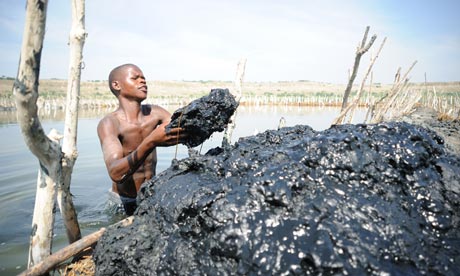
"Digging the salt from Lake Katwe involves standing waist or chest deep in toxic water for hours at a time." (James Ewen/Earthmedia)
Why the Salt Miners of Uganda's Lakes Are Dying for a Deal on Climate Change
By James Randerson
The Observer, November 21, 2010
"Didas Yuryahewa, bent double and waist-deep in water, holds his breath as he struggles to gouge out another shovel of stinking black mud. The air is thick with the bad-egg stench of hydrogen sulphide mixed with ammonia. The equatorial sun beats down on his naked back, leaving a salty sheen. In the good times, Yuryahewa -- and hundreds of other salt miners at Lake Katwe in western Uganda -- can make a reasonable living, but it is a casino existence. Salt production turns rapidly from boom to bust with the seasons, leaving the workers struggling to make ends meet, and climate change is starting to load the dice against them. The gathering of environment ministers and officials at UN climate talks in Cancun, Mexico, on 29 November may seem a world away, but development campaigners say progress towards a deal to raise $100bn (£62bn) a year by 2020 to help poorer countries such as Uganda adapt to climate change is essential. The climate change fund was seen as one of the few successes to come out of the ill-fated Copenhagen talks last December. Two weeks ago, leading economists, finance ministers and heads of state came up with a draft plan for how the money could be raised -- including a mixture of carbon taxes, aviation and shipping taxes, and the redirection of fossil fuel subsidies. At Cancun, negotiators are expected to inch closer to an agreement on finance, but progress on reducing the world's carbon emissions looks to be as far away as ever.

Tuesday, November 16, 2010

GOVERNANCE & CONFLICT (Uganda)

Museveni's NRA Raped Acholi Men in Revenge
By Timothy Nsubuga
Uganda Correspondent, September 27, 2010
"Powerful and heartbreaking allegations and testimonies by a number of human rights activists and ordinary people from northern Uganda suggest that Yoweri Museveni’s NRA soldiers gang-raped Acholi men soon after they captured power in 1986. The allegations, seen by Uganda Correspondent, are contained in an award winning 2008 documentary film called 'Gender Against Men' that was shot by the Refugee Law Project based at Makerere University-Kampala. The commentary, done by someone with a feminine sounding voice, says in the affirmative that, '... Acholi soldiers were largely blamed for atrocities committed in central Uganda while fighting the rebel insurgency of President Yoweri Museveni.  In northern Uganda, after Museveni’s National Resistance Army took power in 1986, some of his soldiers sought revenge by using sexual violence against Acholi men.' The NRA's revenge rape against Acholi men for crimes that Acholi soldiers allegedly committed in 'Luwero Triangle' and other parts of central Uganda were not one off isolated incidents either.  According to the documentary, '... it was widespread enough that the Acholi invented a new vocabulary to describe this new [NRA] tactic.' The Acholi, the documentary said, described the rape of men as 'tek gungu.' The explanatory subtitles in that specific part of the documentary translated 'tek gungu' to literally mean 'the way which is hard to bend.'

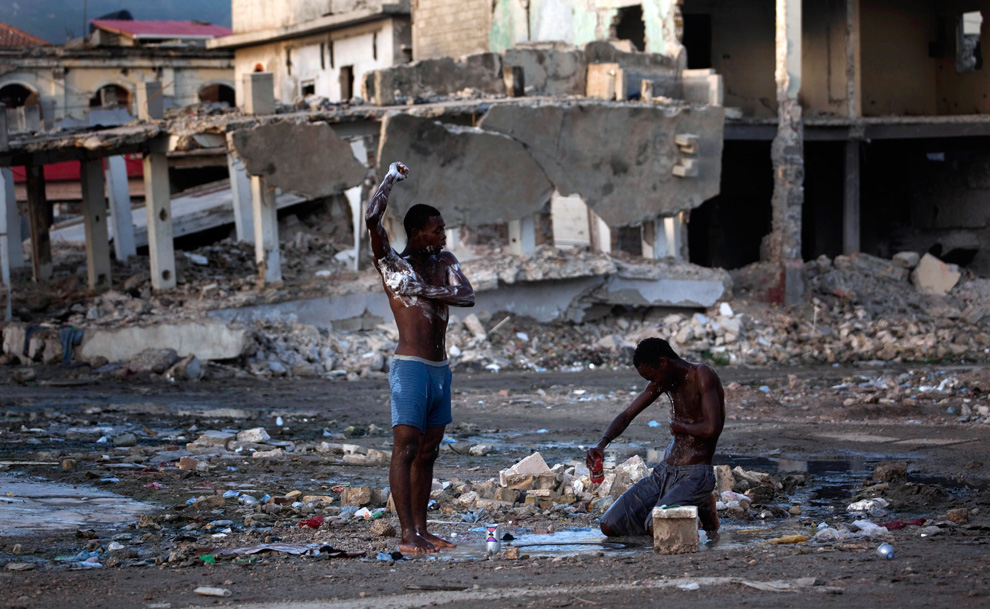
Photo of the Day

"Men bathe in puddled water on a street in Port-au-Prince, Haiti on Wednesday, Sept. 22, 2010." (AP/Ramon Espinosa)
(Click on the image for a much larger version) 

Wednesday, November 10, 2010

FAMILY & SEXUALITY (India)

"Members of the National Handicapped Party participate in a protest in New Delhi." (EPA)
Delhi Announces Pension Plan for Eunuchs in Bid to Keep Them Off the Streets
By Dean Nelson
The Telegraph, November 10, 2010
"The Municipal Corporation of Delhi (MCD) has announced it will pay all adult eunuchs in the capital 1000 rupees (£14) per month as an acknowledgement that they suffer as much as other minorities and disadvantaged groups. The corporation had considered hiring eunuchs as tax collectors, but abandoned the idea over concerns about their methods. Under the new scheme, each of the city's 272 councillors has the power to offer pensions to 700 people. Now eunuchs will be eligible for these pensions once they have proved their age and status -- they will also need a medical certificate confirming they no longer have male genitalia. India has an estimated 1.5 million eunuchs, known locally as 'hijras' or 'kinnar,' who are both feared and persecuted throughout the country. Their leaders are campaigning for official recognition as a 'third sex' and reservations for government jobs and university places. Most 'kinnar' are men born with deformed genitals who later undergo dangerous 'village castrations' to complete their transformation, while others are effeminate boys disowned by their families or sent to live with eunuch communities and earn their keep through begging. They were once held in high esteem in India's royal households and during the Mughal period rose to high positions at court. They were trusted to guard the royal harems or zenanas because they posed no sexual threat. Their decline has mirrored that of royalty itself in the subcontinent, and today most make a living by singing and dancing at weddings or soliciting money for 'blessings' from courting couples in public parks. Some have taken a more aggressive turn and openly extort money with threats of violence. The move by Delhi's local government will not give eunuchs enough to live on or abandon their need to continue their 'tolly' collection rounds, but officials hope it will encourage them to reform. 'It's more of a symbolic gesture than an actual help, but certainly it will give them a sense of being a part of the society and help them rehabilitate,' said MCD spokesman Deep Mathur."
[n.b. This is the complete text of the dispatch.]

Saturday, November 6, 2010

Video of the Month


The extraordinary three-part BBC documentary Welcome to Lagos includes some of the most vivid glimpses ever captured of the lives of men in the developing world. Amidst the pulse and chaos of Nigeria's megalopolis, rubbish-dump worker and would-be rapper Eric (episode 1, pictured) and Chubbie, a fisherman working to support eighteen children (episode 2), share their lives and dreams. Episode 3 focuses on a vibrant young woman named Esther, living rough on the beaches of Lagos lagoon, and is also essential viewing.

A high-quality rip of the three-part series is also torrented on The Pirate Bay at the time of writing:
Episode 1 - Episode 2 - Episode 3