Monday, January 21, 2013

WORK (D.R. Congo)

"A man in Goma, Democratic Republic of Congo, transports a diesel generator on his chikudu, a primitive wooden bicycle capable of carrying heavy loads." (Jerome Delay/Associated Press)
Congo's Chairmen of the Boards
By Robyn Dixon
The Los Angeles Times, January 21, 2013
"It's an ungainly beast of a machine: a wooden bicycle with handlebars like great bull's horns, two runtish wooden wheels, a chunky frame like a squashed triangle and no pedals. There's no seat either, just a kneepad fixed to the frame, made from a spongy Chinese flip-flop. The Congolese chikudu looks like it rolled right off the pages of a child's drawing book and onto the rutted roads of eastern Democratic Republic of Congo. Uzima Bahati, 18, was a child himself when he became a chikudu operator. He left school when he was about 12, and has spent the last six years pushing astonishing loads on the surprisingly sturdy contraption, his whole body bent to the task. 'It really helped me in life because it's like a free job,' he says. 'When I get enough money each day, I can go home and buy food.' He's so proud of his chikudu that he spent $5 -- more than twice the average daily wage here -- for brown and white paint and brushes, to make it look smart. In careful but wobbly script, he painted his cellphone number on the vehicle along with maxims such as 'A job's a job' and 'Stop talking so much.' The latter, he says, shows he doesn't care what anyone thinks of him, even if they're laughing. Other chikudu riders (or rather pushers, since it's rare that the owners actually get to ride the lumbering machines) taunt Bahati for his painted version, which by Congolese standards is almost gaudy. Most of them are battered and stained grayish. 'My friends laugh at me, saying: "You have money to spend on nothing. You could use the money you spent on paint to buy something useful,"' says Bahati, a layer of thick grime coating his body. 'When they laugh, I don't feel bad.' His eyes dart about with curious amusement, a semi-smile fixed on his lips. When he's working, which is every day, he wears a shirt worn to a web of holes. But before meeting his sweetheart or hosting visitors, he dons a crisp white jacket and pristine trousers.

Wednesday, January 16, 2013

FAMILY & SEXUALITY (India)

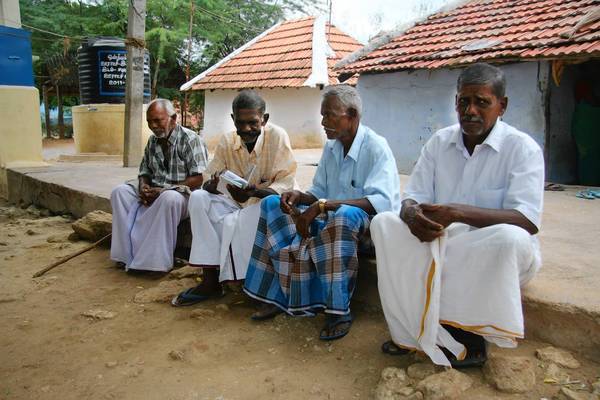
"Indian men in the village of Innamrediyarpatti, from left: pipe fitter Ponnusamy, 67; retiree Dhanushkoti, 63; farmer Kalimuthu, 60; and textile mill worker Michael, 62. Even as India debates the morality and legality of euthanasia, three districts in the southern state of Tamil Nadu have been quietly carrying out their own version of it." (Mark Magnier / Los Angeles Times)
In Southern India, Relatives Sometimes Quietly Kill Their Elders
By Mark Magnier
The Los Angeles Times, January 15, 2013
""[...] Even as India debates the morality and legality of euthanasia, three districts in the southern state of Tamil Nadu have been quietly carrying out a homegrown version for decades, or centuries, depending on whom you ask. The practice in one small corner of India has declined under the spotlight after a high-profile 2010 case and growing opposition from elderly rights groups, but dozens, even hundreds, of cases of thalaikoothal, or 'head pouring,' occur quietly each year, people say. 'Some call it euthanasia,' said Rajeshwar Devarakonda, social protection head at HelpAge India, a civic group focused on elderly care. 'Others call it homicide.' Although it can take various forms, a common approach is that once an elderly relative becomes seriously ill and the family can't afford to care for the person, a date is set. Often relatives are called to say goodbye or even participate. The victim is given an oil bath, a head massage perhaps involving cold water and an exceedingly large amount of green coconut milk, leading to death. Reducing a sick or frail person's body temperature can bring on heart failure, said Dr. Raja Natrajan, a geriatrician, while drinking excessive liquids can induce renal failure. In a variation, victims are force-fed cow's milk and their noses pinched shut -- an act called 'milk therapy' -- resulting in 'breathing problems,' said S. Gurusamy, a sociology professor at the Gandhigram Rural Institute. [...] Despite community claims that it's used only in terminal cases, social acceptability has resulted in abuses, care experts said, as impatient family members 'hurry things along' to gain control of the estate, sometimes with the help of compliant doctors or quacks who substitute poison-laced alcohol or pills for coconut milk. 'Nowadays, because of their assets, young people sometimes want thalaikoothal done even if it's just a cold or minor sickness,' said Elango Rajarathinam, Virudhunagar-based director of Elders for Elders Foundation. 'Old people are definitely scared of this practice. You can see the stress on their faces.' Occasionally, those targeted get wind of it and flee. Others just accept their fate, experts said, even requesting thalaikoothal, less because they're ready to die than because society makes them feel worthless. [...]  Although women's status in India is often low, men are more frequently the victims of thalaikoothal, experts said, in part because assets are generally in their names, providing an incentive. Also, daughters-in-law who provide most elder care are reluctant to assist men, given social taboos. In addition, some perceive men's housekeeping skills as limited in male-dominated India, leaving them seemingly dependent.

Thursday, January 3, 2013

RITUAL & BELIEF (South Africa)

Ndiyindoda: I Am a Man
People and Power - Al Jazeera.com, January 3, 2013
"A week before Christmas, amid increasing anxiety about the state of Nelson Mandela's health, the international media assembled in Pretoria, South Africa and began asking questions about the iconic former leader's future wellbeing. Would he ever leave hospital? Would he live to see another year? For domestic South African journalists, however, the story had another angle. In Mandela's Eastern Cape homeland, the breaking story was that his illness meant he would almost certainly miss his grandson's initiation ceremony back home in Qunu. Mandela, like many powerful political figures in South Africa, is a Xhosa. For Xhosa boys, their ceremonial transition to manhood -- a process known as Ukwaluka -- includes traditional circumcision. It is a time honoured ritual woven deep into the fabric of their society. Mandela recalled his own three months at initiation school in 1934 in his memoir A Long Walk To Freedom. 'An uncircumcised Xhosa man is a contradiction in terms,' he wrote, 'for he is not considered a man at all, but a boy. A boy will cry, but a man conceals his pain.' [n.b. Mandela's account is included in my Men of the Global South anthology.] Today's rites of passage ceremonials tend to last for three weeks rather than three months, but the core elements remain the same -- and so do the risks.

Monday, December 31, 2012

GOVERNANCE & CONFLICT (Syria)

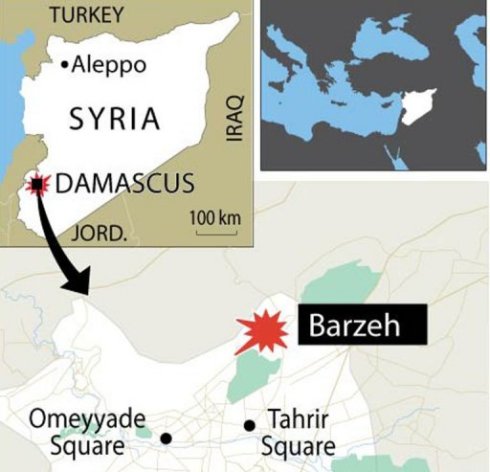
Dozens of Tortured Bodies Found in Damascus
Agence France-Presse dispatch on Yahoo! News, December 31, 2012
"Dozens of tortured bodies have been found in a flashpoint district of Damascus, a watchdog reported on Monday, in one of the worst atrocities in Syria's 21-month conflict. The report from the Syrian Observatory for Human Rights came as a gruesome video emerged on the Internet of a separate slaying of three children who had their throats slashed, also in the capital. 'Thirty bodies were found in the Barzeh district. They bore signs of torture and have so far not been identified,' said the Britain-based Observatory. The Syrian Revolution General Commission, a grassroots network of anti-regime activists, estimated there were 50 bodies, and added that 'their heads were cut and disfigured to the point that it was no longer possible to identify' them. The video posted online by activists showed the bodies of three young boys with their throats slit open and hands bound behind their backs. Their bodies were discovered on Monday in Jubar. The Observatory also reported the killing of the boys, who opposition activists said had been kidnapped the day before at a checkpoint on their way home from school. These reports could not be verified independently because of media restrictions by the Syrian authorities. Regime warplanes, meanwhile, bombarded rebel positions on the northeastern and southwestern outskirts of Damascus, leaving eight civilians dead including two children, said the Observatory. [...]"
[n.b. When you read "dozens of tortured bodies," translate as "dozens of tortured males." Can you imagine dozens of murdered females being described in this fashion?]

Sunday, December 30, 2012

GOVERNANCE & CONFLICT (Nigeria)

In Nigeria, Trapped between Islamist Radicals and Security Forces
By Sudarsan Raghavan
The Washington Post, December 30, 2012
"The armed men dragged Musa Muhammad out of his house and ordered him to lie face down on the ground. Then they grabbed his son. After asking his name, the men issued their judgment. 'I heard three gunshots -- pop, pop, pop,' Muhammad recalled, his voice trembling, his fingers in the shape of a pistol. 'My son was dead, killed in front of me.' His assailants were not the radical Islamists who have brutalized this town. They were government security forces sent to protect the residents. In the epicenter of one of Africa's most violent religious extremist movements, civilians are caught in a guerrilla conflict that has shattered families and communal relationships. The Boko Haram, a homegrown group with suspected ties to al-Qaeda, is assassinating people nearly every day, targeting Christians, soldiers, police, even astrologers as it seeks to weaken the Western-allied government and install Islamic sharia law in this nation. But the security forces have also carried out extrajudicial killings, imprisoned hundreds on flimsy grounds, looted and burned shops and houses, according to victims, local officials and human rights activists. ... 'In a guerrilla war, you need the help of the local population. But the security forces are alienating the people,' said Muhammad Abdullahi, the provincial director of religious affairs. 'They are making their jobs more difficult for themselves.'

GOVERNANCE & CONFLICT (Pakistan)

"Pakistan militants punish accused informers aiding drone attacks by taping their confessions and executions." (The New York Times)
Drone War Spurs Militants to Deadly Reprisals
By Declan Walsh
The New York Times, December 29, 2012
"They are dead men talking, and they know it. Gulping nervously, the prisoners stare into the video camera, spilling tales of intrigue, betrayal and paid espionage on behalf of the United States. Some speak in trembling voices, a glint of fear in their eyes. Others look resigned. All plead for their lives. 'I am a spy and I took part in four attacks,' said Sidinkay, a young tribesman who said he was paid $350 to help direct CIA drones to their targets in Pakistan's tribal belt. Sweat glistened on his forehead; he rocked nervously as he spoke. 'Stay away from the Americans,' he said in an imploring voice. 'Stay away from their dollars.' Al Qaeda and the Taliban have few defenses against the American drones that endlessly prowl the skies over the bustling militant hubs of North and South Waziristan in northwestern Pakistan, along the Afghan border. CIA missiles killed at least 246 people in 2012, most of them Islamist militants, according to watchdog groups that monitor the strikes. The dead included Abu Yahya al-Libi, the Qaeda ideologue and deputy leader. Despite the technological superiority of their enemy, however, the militants do possess one powerful countermeasure. For several years now, militant enforcers have scoured the tribal belt in search of informers who help the CIA find and kill the spy agency's jihadist quarry.

Saturday, December 22, 2012

WORK / MIGRATIONS (Malaysia)

Worked to Death
AlJazeera.com, October 30, 2012
"Thousands of foreign workers have died in Malaysia in recent years from accidents, illnesses and suicide. They work in so-called '3D' conditions -- dirty, dangerous and difficult. Critics say the death rate is a result of slack safety standards, poor housing conditions and weak enforcement of laws to protect them. Last year, more than 1,000 foreign workers died from accidents, illnesses and suicide. Malaysia is the largest importer of labour in Asia. Migrant workers provide cheap labour in construction, manufacturing and plantation industries. There are more than three million foreign workers, of which nearly a third is undocumented.  Most of the migrant workers come from Bangladesh, India, Indonesia and Nepal. Desperate to repay debts from the high recruitment agency fees and under financial pressure from their families back home, migrant workers are vulnerable to exploitation. Many suffer non-payment of wages, abuse, serious injuries and even death. On this episode, the 101 East team meets those who risk it all to make a living in Malaysia and ask: Is enough being done to keep them safe?"