Sunday, August 28, 2011

GOVERNANCE & CONFLICT (Palestine-Israel)

"Boys throw stones at Israeli soldiers." (AFP)
How Israel Takes Its Revenge on Boys Who Throw Stones
By Catrina Stewart
The Independent, 26 August 2011
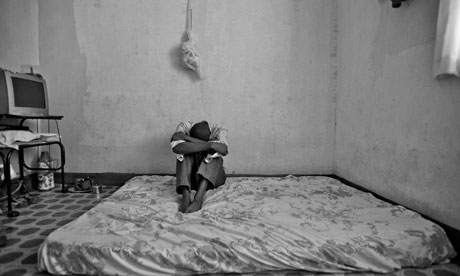
"The boy, small and frail, is struggling to stay awake. His head lolls to the side, at one point slumping on to his chest. 'Lift up your head! Lift it up!' shouts one of his interrogators, slapping him. But the boy by now is past caring, for he has been awake for at least 12 hours since he was separated at gunpoint from his parents at two that morning. 'I wish you'd let me go,' the boy whimpers, 'just so I can get some sleep.' During the nearly six-hour video, 14-year-old Palestinian Islam Tamimi, exhausted and scared, is steadily broken to the point where he starts to incriminate men from his village and weave fantastic tales that he believes his tormentors want to hear. This rarely seen footage seen by The Independent offers a glimpse into an Israeli interrogation, almost a rite of passage that hundreds of Palestinian children accused of throwing stones undergo every year. Israel has robustly defended its record, arguing that the treatment of minors has vastly improved with the creation of a military juvenile court two years ago. But the children who have faced the rough justice of the occupation tell a very different story. 'The problems start long before the child is brought to court, it starts with their arrest,' says Naomi Lalo, an activist with No Legal Frontiers, an Israeli group that monitors the military courts. It is during their interrogation where their 'fate is doomed', she says. Sameer Shilu, 12, was asleep when the soldiers smashed in the front door of his house one night. He and his older brother emerged bleary-eyed from their bedroom to find six masked soldiers in their living room. Checking the boy's name on his father's identity card, the officer looked 'shocked' when he saw he had to arrest a boy, says Sameer's father, Saher. 'I said, "He's too young; why do you want him?" "I don't know," he said'. Blindfolded, and his hands tied painfully behind his back with plastic cords, Sameer was bundled into a Jeep, his father calling out to him not to be 'We cried, all of us,' his father says. 'I know my sons; they don't throw stones.'

Friday, August 26, 2011

GOVERNANCE & CONFLICT / FAMILY & SEXUALITY (Uganda / Congo)

"Dying of shame: a Congolese rape victim, currently resident in Uganda. This man’s wife has left him, as she was unable to accept what happened. He attempted suicide at the end of last year." (Will Storr/Observer)
The Rape of Men
By Will Storr
The Observer, July 17, 2011
"Of all the secrets of war, there is one that is so well kept that it exists mostly as a rumour. It is usually denied by the perpetrator and his victim. Governments, aid agencies and human rights defenders at the UN barely acknowledge its possibility. Yet every now and then someone gathers the courage to tell of it. This is just what happened on an ordinary afternoon in the office of a kind and careful counsellor in Kampala, Uganda. For four years Eunice Owiny had been employed by Makerere University's Refugee Law Project (RLP) to help displaced people from all over Africa work through their traumas. This particular case, though, was a puzzle. A female client was having marital difficulties. 'My husband can't have sex,' she complained. 'He feels very bad about this. I'm sure there's something he's keeping from me.' Owiny invited the husband in. For a while they got nowhere. Then Owiny asked the wife to leave. The man then murmured cryptically: 'It happened to me.' Owiny frowned. He reached into his pocket and pulled out an old sanitary pad. 'Mama Eunice,' he said. 'I am in pain. I have to use this.' Laying the pus-covered pad on the desk in front of him, he gave up his secret. During his escape from the civil war in neighbouring Congo, he had been separated from his wife and taken by rebels. His captors raped him, three times a day, every day for three years. And he wasn't the only one. He watched as man after man was taken and raped. The wounds of one were so grievous that he died in the cell in front of him. 'That was hard for me to take,' Owiny tells me today. 'There are certain things you just don't believe can happen to a man, you get me? But I know now that sexual violence against men is a huge problem. Everybody has heard the women's stories. But nobody has heard the men's.'

GOVERNANCE & CONFLICT (Libya)

The Short Life and Cruel Death of Libyan Freedom Fighter Izz al-Arab Matar
By Hisham Matar
The Guardian, August 26, 2011
"My cousin Izz al-Arab Matar, a 22-year-old final-year student in engineering, was shot in Bab al-Aziziya, Muammar Gaddafi's fortified compound in Tripoli, at 4.30pm on Tuesday 23 August 2011. 'Izzo', as his friends and family liked to call him, had joined the rebel front immediately after the revolution started on 17 February. He fought in the liberation of his hometown of Ajdabiya, helped liberate Brega and then went on to join the rebels in Misrata. He would return home to his family in Ajdabiya occasionally to rest, get a change of clothes and eat a proper meal before setting off again. Every time his mother would ask him not to leave. He would reply by jokingly quoting from Gaddafi's defiant, savage speech, made a few days after the rebellion began: 'Forward, forward.' She once asked him: 'Forward until when? When will you stop fighting?' 'When we reach Bab al-Aziziya,' he told her.

Monday, March 21, 2011

GOVERNANCE & CONFLICT (Libya)

"A wall outside the Benghazi courthouse bears images of men who have been imprisoned or killed by Moammar Kadafi." (Luis Sinco/Los Angeles Times)

1996 Prison Massacre a Spark in Libyan Revolution
By Raja Abdulrahim
The Los Angeles Times, March 19, 2011
"Every month for nearly 10 years, Ezzedin abu Azza's family traveled to the gates of Abu Salim prison in Tripoli to deliver a package of clothes, food and medicine, not knowing whether it ever reached him. They hadn't seen him since the day in 1993 when the 23-year-old was taken away for questioning by state security agents. But still they made their journey from Benghazi every month. Then, in 2002, the family was told he had died, six years earlier. Here in this eastern city that has long simmered with resentment over the brutal rule of Moammar Kadafi, the Abu Azzas were among the lucky ones. Other families would wait another six years, or longer, to hear that their loved ones were among a reported 1,200 political prisoners at Abu Salim who were killed, in a matter of hours, in June 1996 as they fought for better living conditions and the right to see their families. Other families have never been officially informed and only assume that their loved ones are among the dead. When the government in 2008 began notifying many of the families of the deaths, they set up mourning tents and posted obituaries. 'We were notified 12 years after his death,' many obituaries read, brashly pointing an accusatory finger at the government. Now, a decade and a half after the massacre, the prisoners' stories and an unprecedented call for justice by their families helped spark a revolution.

Tuesday, March 15, 2011

Video of the Month


(Discovery Channel, 2006, 93 mins.)

This heart-stopping account of the attempt to prevent Europe being engulfed in nuclear disaster is one of the greatest documentaries of recent years. Though Ukraine is not formally part of the Global South, it could be considered as such, and in any case this documentary speaks to the wider phenomenon of males conscripted, or volunteering, for the most dangerous tasks in the public sphere. Five hundred thousand men battled the nuclear catastrophe at Chernobyl. Thousands died, and as the documentary makes clear, they are still dying, long before their time. It is additionally powerful to view "The Battle of Chernobyl" in March 2011, as Japan undergoes its own nuclear crisis, with men again at the forefront of the disaster response.

Tuesday, March 8, 2011

GOVERNANCE & CONFLICT / MIGRATIONS (Libya)

"Hundreds of African migrant workers, many from Ghana and Nigeria, live next to the airport in Tripoli, Libya, hoping to fly home." (Moises Saman/The New York Times)
Libya War Traps Poor Immigrants at Tripoli's Edge
By David D. Kirkpatrick and Scott Sayare
The New York Times, March 7, 2011
"As wealthier nations send boats and planes to rescue their citizens from the violence in Libya, a new refugee crisis is taking shape on the outskirts of Tripoli, where thousands of migrant workers from sub-Saharan Africa have been trapped with scant food and water, no international aid and little hope of escape. The migrants -- many of them illegal immigrants from Ghana and Nigeria who have long constituted an impoverished underclass in Libya -- live amid piles of garbage, sleep in makeshift tents of blankets strung from fences and trees, and breathe fumes from a trench of excrement dividing their camp from the parking lot of Tripoli's airport. For dinner on Monday night two men killed a scrawny, half-plucked chicken by dunking it in water boiled on a garbage fire, then hacked it apart with a dull knife and cooked it over an open fire. Some residents of the camp are as young as Essem Ighalo, 9 days old, who arrived on his second day of life and has yet to see a doctor. Many refugees said they had seen deaths from hunger and disease every night. The airport refugees, along with tens of thousands of other African migrants lucky enough to make it across the border to Tunisia, are the most desperate contingent of a vast exodus that has already sent almost 200,000 foreigners fleeing the country since the outbreak of the popular revolt against Col. Muammar el-Qaddafi nearly three weeks ago. Dark-skinned Africans say the Libyan war has caught them in a vise. The heavily armed police and militia forces loyal to Colonel Qaddafi who guard checkpoints along the roads around the capital rob them of their money, possessions and cellphone chips, the migrants say. And the Libyans who oppose Colonel Qaddafi lash out at the African migrants because they look like the dark-skinned mercenaries many here say the Libyan leader has recruited to crush the uprising. 'Qaddafi has brought African soldiers to kill some of them, so if they see black people they beat them,' said Samson Adda, 31, who said residents of Zawiyah, a rebellious city, had beaten him so badly that he could no longer walk.

Monday, March 7, 2011

GOVERNANCE & CONFLICT (Libya)

Libyan Rebels Come from All Walks of Life
By Graeme Smith
The Globe and Mail, March 2011
"They sit crammed together in trucks headed to war in the desert, thousands of rebels throwing themselves into battle against Colonel Moammar Gadhafi. They stand united in their hatred of his regime. Three weeks ago, however, these men lived different lives. They wore hard hats, not military berets; they carried hammers, not assault rifles. Their bands of fighters consist mostly of amateurs, facing off against professional forces. In its first public appearance this weekend, the newly formed rebel council in Benghazi promised it would send more seasoned reinforcements from the ranks of defecting troops.
In the meantime, however, the ragtag warriors on the front lines say their passion keeps them going. For many, the wellspring of emotion is their bitter personal history.
'The Businessman' Saif-al-din Sa'd, 33.
Saif-al-din Sa’d, 33, was born in Zwetina, a port town where his father worked for an oil company as a ship's captain. He graduated from a nearby university with a degree in business administration and joined a local construction company. He is now executive director of the firm, with responsibility for 150 employees. He chuckles when informed that his status as a wealthy businessman breaks the stereotype of poor youth rising up: 'Rich or not,' he said, 'it's been like living in prison in this country.' Before the revolution, his proudest accomplishment had been building a water reservoir in the desert. Now, it's the assault on the sandy hill of Ras Al-Nasr, a bluff outside the town of Ras Lanuf. Government forces held the high ground with artillery and heavy guns, but the businessman and his comrades forced them to retreat during a battle waged in a dust storm on March 3. He's more accustomed to wearing hard hats and steel-toed boots during the workday, but Mr. Sa'd seems to take naturally to his rebel uniform. He does not flinch when young fighters bang out practice shots on their anti-aircraft guns nearby and seems unfazed when others panic at the sound of jets overhead. His quiet resolve comes from witnessing the government forces' attacks on civilians, he says. 'I saw with my own eyes, one of them shooting their recoilless rifle at a carload of civilians, all of them killed immediately,' he said. 'We have Libyan blood, this is our blood. This is our country. We will fight with every weapon. We don’t mind dying.' [...]"